
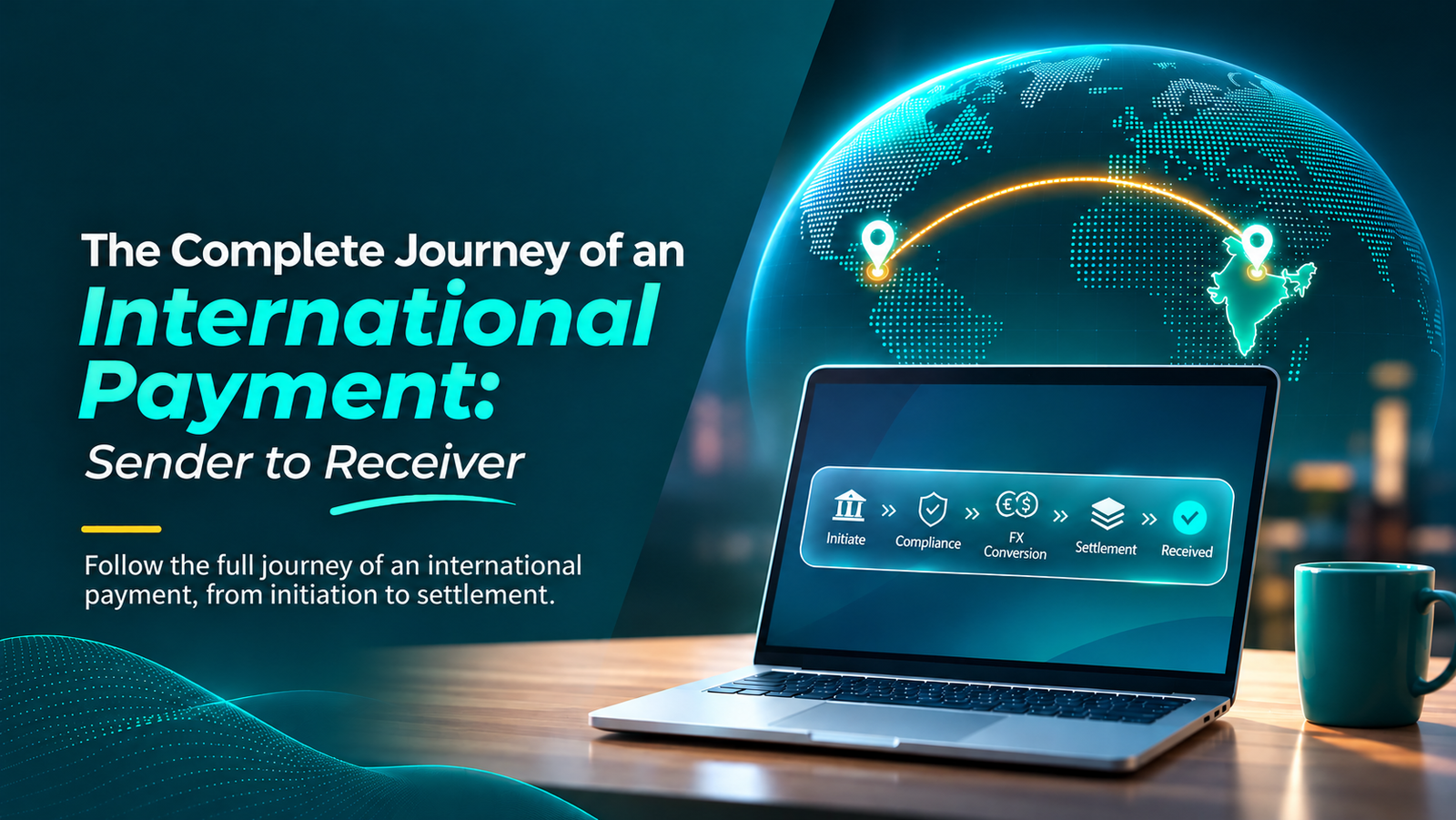
The Complete Journey of an International Payment: Sender to Receiver
Introduction
A family member abroad sends money home. A freelancer gets paid by an overseas client. An exporter receives payment for a shipment. To the person on either end, this often looks simple: money leaves one account and appears in another, sometimes within minutes, sometimes after a few days. Behind that simplicity, though, sits a journey involving several institutions, at least one currency conversion, a compliance process, and a settlement step between banks that never directly touch the sender's or recipient's hands.
This article follows that journey from start to finish, in plain language, bringing together the individual pieces such as banks, correspondent banking, SWIFT messaging, foreign exchange and settlement rails into a single, complete picture. If you have read other articles in this series about specific concepts like correspondent banking or Nostro and Vostro accounts, this piece shows how those pieces fit together into one payment.
Why Does an International Payment Take More Than One Step?
A domestic payment usually stays within one country's banking system, often using a single shared payment network. An international payment, by contrast, needs to cross at least one national border, often a currency boundary, and sometimes a regulatory boundary as well. No single institution typically has direct reach into every country and currency in the world, so the payment needs to pass through a chain of institutions, each handling a specific part of the journey.
Who Is Involved in an International Payment?
Not every payment involves every participant listed here. A simple remittance might only touch a sender's app and a receiving bank, while a larger business payment can involve several of these roles.
| Participant | General Role |
|---|---|
| Sender | The individual or business initiating the payment, providing amount, currency and recipient details |
| Sending Bank or Payment Platform | Processes the outgoing instruction and applies initial checks |
| Correspondent Bank | Provides access to the destination currency or market where a direct relationship does not exist |
| Intermediary Bank | An additional institution sometimes needed when more than one hop is required to reach the destination |
| Receiving Bank | The institution where the recipient holds their account |
| Recipient | The individual or business receiving the funds, usually in their own local currency |
The Complete Journey, Step by Step
Step 1: Sender Initiates the Payment
The journey begins when a sender, whether an individual, freelancer or business, instructs their bank or payment platform to send a specific amount to a named recipient in another country, providing the recipient's banking details and the currency to be used.
Step 2: Sending Bank or Platform Reviews and Processes
The sending institution checks the instruction, verifies the sender's account and details, and carries out standard checks, such as identity verification, before proceeding with the payment.
Step 3: Payment Instructions Are Communicated Internationally
For payments routed through the traditional banking system, the sending bank typically communicates the payment instruction to the next institution in the chain using a financial messaging system such as SWIFT. This message carries the details of the payment. It does not itself move the money.
Step 4: Correspondent Banking Relationships Route the Payment
Where the sending and receiving banks do not have a direct relationship, the payment is routed through a correspondent bank, and sometimes more than one, that holds the necessary account relationships to bridge the two banking systems. This is often where Nostro and Vostro account relationships come into play, since these accounts are what actually allow value to move between the correspondent and respondent banks.
Step 5: Foreign Exchange Conversion Occurs
Where the payment involves a currency conversion, one of the institutions in the chain, whether the sending bank, an intermediary, or the receiving bank, converts the amount using its own exchange rate, which may include a spread over the underlying market rate.
Step 6: Settlement Takes Place Between Institutions
The financial obligation between the institutions involved is settled, often through the correspondent banking accounts described earlier, and for high-value or time-critical payments, sometimes through a domestic real-time gross settlement system in the receiving country.
Step 7: Receiving Bank Processes the Incoming Payment
The recipient's bank receives the funds and the accompanying instructions, verifies the beneficiary's details, and completes any compliance checks required before crediting the account.
Step 8: Recipient Receives the Funds
The recipient's account is credited with the final amount, in their local currency, completing the journey from the customer's point of view.
The Full Payment Flow at a Glance
Sender → Sending Bank/Platform → SWIFT Messaging/Correspondent Banking → FX Conversion → Settlement → Receiving Bank → Recipient
The exact combination of steps, and which specific institutions are involved, depends on the currencies, countries and banks in the transaction, and on the specific payment corridor connecting the sending and receiving countries.
What Role Does Each Concept Play in This Journey?
This series has covered several individual concepts in more depth elsewhere. Here is how each one fits into the overall journey.
| Concept | Where It Fits In the Journey |
|---|---|
| Correspondent Banking | Bridges the sending and receiving banks when they lack a direct relationship |
| Nostro/Vostro Accounts | The actual account relationship correspondent banks use to settle value between each other |
| SWIFT | Carries the payment instructions and details between banks, without moving the money itself |
| AD Category-I Banks | Indian banks authorized to handle the foreign exchange side of the transaction |
| PA-CB Entities | Facilitate the digital, customer-facing collection step for online cross-border trade payments |
| ACH / SEPA / RTGS | Complete the final domestic settlement leg once funds reach the destination country |
| Payment Corridor | The overall route between the two countries, shaped by all of the above working together |
How Long Does the Full Journey Take?
There is no single answer that applies to every payment. Processing time depends on factors such as the number of institutions in the chain, bank cut-off times, time zone differences, the currencies involved, weekends and public holidays, compliance reviews, and whether any real-time payment linkage exists for the specific corridor being used. A payment on a well-connected corridor with a direct correspondent relationship can settle considerably faster than one that needs to pass through multiple intermediary banks.
What Determines the Cost of the Full Journey?
Cost is generally shaped by several layers: a fee from the sending institution, potential charges from any correspondent or intermediary banks in the route, the FX spread applied at whichever point the currency is converted, and a possible receiving-bank fee. This article does not state specific fee amounts, since these vary by institution, corridor and transaction type, and should be confirmed directly with the relevant bank or payment provider.
Where Do Compliance Checks Happen Along the Journey?
Compliance checks, such as identity verification, transaction monitoring and sanctions screening, are not confined to a single point in the journey. The sending institution typically applies checks when the payment is initiated, correspondent or intermediary banks may apply their own checks as the payment passes through, and the receiving bank generally applies checks again before crediting the beneficiary. This is one reason a payment involving more than one institution can take longer than a purely domestic transfer.
How the Journey Differs for Different Senders and Receivers
- An individual sending a personal remittance often uses a simpler route, sometimes through a dedicated remittance platform rather than a traditional bank-to-bank transfer
- A freelancer receiving payment from an overseas client typically relies on their bank's correspondent relationships, or a digital payment platform, depending on how the client pays
- An exporter or importer handling trade payments often deals with an AD Category-I bank, particularly for larger transactions, and may also use a PA-CB regulated platform for smaller, digital collections
- A SaaS or e-commerce business collecting many small, recurring international payments frequently relies on a payment aggregator working alongside its banking partners
Example: The Full Journey for an Indian Exporter
Consider an Indian exporter that has shipped goods to a buyer overseas and is due to be paid in a foreign currency.
- The overseas buyer initiates the payment through their own bank.
- The buyer's bank reviews the instruction and communicates it internationally, often using SWIFT messaging.
- If the buyer's bank and the exporter's Indian bank do not have a direct relationship, the payment is routed through one or more correspondent banks.
- The relevant currency conversion takes place at some point in this chain.
- The Indian bank, generally an AD Category-I institution for this type of transaction, receives and processes the incoming payment, applying its own compliance checks.
- The exporter's account is credited, and the exporter reconciles the amount against the original invoice.
Example: The Full Journey for an Indian Importer
Consider an Indian business paying an overseas supplier for imported goods.
- The Indian business instructs its bank to pay the supplier in the relevant foreign currency.
- The Indian bank processes the instruction and applies compliance checks.
- Where a direct relationship with the supplier's bank does not exist, the payment is routed through a correspondent bank.
- SWIFT messaging communicates the payment details between the institutions involved.
- The supplier's bank receives, verifies and credits the payment, completing the transaction.
- The Indian importer reconciles the debited amount, including any applicable charges, against its purchase records.
What Can Go Wrong Along the Journey?
- Incorrect or incomplete beneficiary details, which can delay or return a payment
- Outdated bank information, particularly if a recipient has changed banks
- Missing documentation needed for compliance checks at one of the institutions involved
- Delays caused by bank cut-off times, weekends or public holidays
- Additional processing time when more than one intermediary bank is involved
This article does not guarantee any specific outcome, since the impact of an issue depends on the banks and route involved in a given transaction.
Common Misconceptions About How International Payments Work
“The Money Physically Moves Through Every Bank in the Chain”
Not accurate. Settlement generally happens through account relationships and book entries between institutions, rather than physical currency travelling from bank to bank.
“SWIFT Transfers the Money”
Not accurate. SWIFT carries payment instructions. The actual movement and settlement of funds happens through the banking relationships and rails connecting the institutions involved.
“Every International Payment Follows the Exact Same Route”
Not accurate. The specific institutions and steps involved depend on the currencies, countries, banks and payment corridor in question.
“A Payment Either Works Instantly or Fails”
Not accurate. Many payments proceed successfully but simply take time to pass through each stage of the journey, particularly when compliance checks or multiple institutions are involved.
Quick Reference: Journey Stage to Concept
| Journey Stage | Relevant Concept |
|---|---|
| Payment initiated | Sender and sending bank or platform |
| Instructions communicated internationally | SWIFT messaging |
| Payment routed between banking systems | Correspondent banking, Nostro/Vostro accounts |
| Currency converted | Foreign exchange |
| Foreign exchange side processed in India | AD Category-I bank |
| Digital collection for online trade | PA-CB regulated platform |
| Final domestic settlement | ACH, SEPA or RTGS, depending on the country |
| Overall route between two countries | Payment corridor |
Practical Checklist Before Sending or Expecting an International Payment
- Confirm the recipient's full and current banking details before initiating a payment
- Ask your bank or platform which route and rails will likely be used for your specific transaction
- Understand which fees and FX costs may apply along the route
- Set realistic expectations for timing, particularly for less-connected corridors
- Keep supporting documentation ready in case compliance checks are needed
- Reconcile the final credited or debited amount against your invoice once the payment completes
Conclusion
An international payment that looks like a single, simple transaction from the outside is, underneath, a coordinated journey involving several institutions, a currency conversion, compliance checks, and a settlement process between banks. Understanding the individual pieces, from correspondent banking and SWIFT messaging to AD Category-I banks, PA-CB platforms, domestic rails like ACH, SEPA and RTGS, and the overall payment corridor connecting two countries, makes it easier to see why a payment moves the way it does.
For anyone sending or receiving money across borders, whether a personal remittance, a freelance payment, or a business transaction, this bigger picture helps set realistic expectations around timing and cost, and makes the individual concepts covered elsewhere in this series easier to place within the full journey from sender to receiver.